by Irv Krick | Jul 29, 2021 | Windows 10
You don’t need to spend money to get a quality photo editor. In fact, you don’t even need to download an app.
 Some powerful photo editors require a monthly subscription fee or a high initial investment. Photopea bucks both of these trends, and instead gives you a free option that doesn’t even require you to download anything.
Photopea is a unique editing application — I’ve never used anything like it. It’s a Photoshop alternative that you just open in your web browser. Both the interface and its feature list will be familiar to anyone who has used Photoshop. While it doesn’t have every feature of Adobe’s flagship photo editor, Photopea isn’t a lightweight editor either. It has enough power and features to keep many users from having to purchase a photo editing software.
It’s free and open source, with some ads that help support its development, but the ads aren’t intrusive. You can upgrade to a premium account for $9 per 30 days to remove ads and support the developer.
Web-based editing
Photopea
A powerful photo editor that lives in your browser.
Photopea is a powerful photo editor that’s a progressive web app — it lives in your browser. You can use it to make edits to photos, enhance them, and use both vector and raster tools all without having to download a thing.
Power within a browser
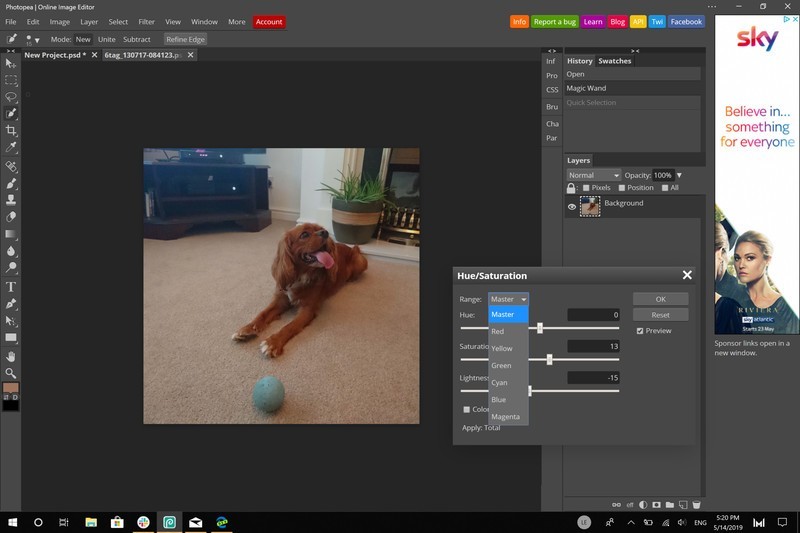
Photopea looks and feels like Adobe Photoshop, and that’s a good thing because it feels very familiar to creators. If you’ve used any photo editing software that has a similar design, you’ll be able to dive right into Photopea. You can make global edits like adjusting an image’s HSL or brightness, and also make more specific edits like selecting an image from a background. It works with raster images and vectors and supports several file formats.
What’s impressive about this to me is that it’s all within your browser. Photopea doesn’t require a download. It’s a PWA that you can either use inside a normal browser interface or “install” as an app through browsers such as Google Chrome or the version of Microsoft Edge that’s powered by Chromium. But even when “installed”, you still don’t have to download anything. The app is in your browser, but the editing is done on your machine. All of your work is stored locally, so nothing is put into a server or a cloud.
Because of how Photopea works, you can open it instantly on just about any machine, including PCs running Windows 10 in S Mode or even Chromebooks. It works with PSD files well and also supports the vast majority of file formats that image editors will need. It’s a great photo editor for working across platforms and being able to jump into an edit on any device without having to download anything.
Editing anywhere
Photopea’s most significant selling point is that it’s so easy to use anywhere. It works very well with PSD files, with support for layer editing and saving a file as a PSD file. That means that you can take a file that you have on the cloud, a USB drive, or any device, and make some quick edits on any device without having to download anything.
For a professional user, Photopea isn’t going to replace Photoshop, though that’d be a big thing to ask from a free piece of software. Instead, Photopea is an excellent companion for photo editors who need to make edits on a machine that isn’t their normal setup.
If you’re a prosumer or casual editor, Photopea will meet many of your demands. It’s convenient, can handle a wide range of edits, and is easy to learn thanks to Photopea’s online tools.
An impressive and convenient editor
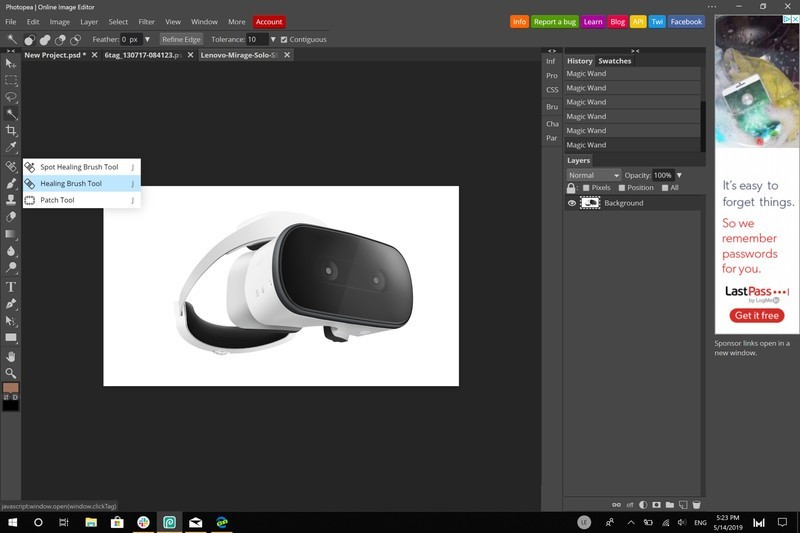
I’m a fan of Photopea. It’s unique, is a progressive web app, and can work on just about any platform. I love that it supports PSD files so well and plays nicely with other file formats. It’s a good companion for professional users who have to make an edit on a machine other than their usual setup and a good editor for prosumers and casual editors looking for something more than a basic editor.
4 out of 5
I ran into some performance issues when I tested it, which is unfortunate. Selecting a background to remove was a bit janky in my testing, but other edits ran smoothly. It’s hard to judge how much that will vary for each person as hardware setups can differ significantly. What I can say is that editing in Photopea was less smooth than using my photo editor of choice, Affinity Photo. That being said, Photopea still performed fairly well, and the fact that it’s free and can be tested by literally clicking on a link makes it worth a try for anyone on the hunt for a photo editor.
Pros
- Free version isn’t restricted
- Large feature set
- Doesn’t require a download
- Can work in several browsers
Cons
- Performance can stutter during edits
by Irv Krick | Jun 30, 2021 | Windows 10
What’s the Best Antivirus for Windows 10? (Is Windows Defender Good Enough?)  Windows 10 won’t hassle you to install an antivirus like Windows 7 did. Since Windows 8, Windows now includes a built-in free antivirus called Windows Defender. But is it really the best for protecting your PC–or even just good enough? Windows Defender was originally known as Microsoft Security Essentials back in the Windows 7 days when it was offered as a separate download, but now it’s built right into Windows and it’s enabled by default. Many people have been trained to believe that you should always install a third-party antivirus, but that isn’t the best solution for today’s security problems, like ransomware. So What’s the Best Antivirus? Please Don’t Make Me Read All This
  What you need is a great team: Malwarebytes + Windows Defender We definitely recommend you read the entire article so you fully understand why we recommend a combination of Windows Defender and Malwarebytes, but since we know that tons of people will just scroll down and skim, here is our TL;DR recommendation for how to keep your system secure:
- Use the Built-in Windows Defender for traditional antivirus – the criminals have moved on from regular viruses to focus on Ransomware, zero-day attacks, and even worse malware that traditional antivirus just can’t handle. Windows Defender is built right in, blazing fast, doesn’t annoy you, and does its job cleaning old-school viruses.
- Use Malwarebytes for Anti-Malware and Anti-Exploit – all of the huge malware outbreaks these days are using zero-day flaws in your browser to install ransomware to take over your PC, and only Malwarebytes provides really excellent protection against this with their unique anti-exploit system. There’s no bloatware and it won’t slow you down.
Editor’s Note: This doesn’t even mention the fact that Malwarebytes, the company, is staffed by some really great people that we really respect. Every time we talk to them, they are excited about the mission of cleaning up the internet. It’s not often that we give an official How-To Geek recommendation, but this is our favorite product by far, and something we use ourselves. A One-Two Punch: Antivirus and Anti-Malware You need antivirus software on your computer, no matter how “carefully” you browse. Being smart isn’t enough to protect you from threats, and security software can help act as another line of defense. ADVERTISEMENT However, antivirus itself is no longer adequate security on its own. We recommend you use a good antivirus program and a good anti-malware program. Together, they will protect you from most of the biggest threats on the internet today: viruses, spyware, ransomware, and even potentially unwanted programs (PUPs)—among many others. So which ones should you use, and do you need to pay money for them? Let’s start with the first part of that combo: antivirus. Is Windows Defender Good Enough?  When you install Windows 10, you’ll have an antivirus program already running. Windows Defender comes built-in to Windows 10, and automatically scans programs you open, downloads new definitions from Windows Update, and provides an interface you can use for in-depth scans. Best of all, it doesn’t slow down your system, and mostly stays out of your way—which we can’t say about most other antivirus programs. For a short while, Microsoft’s antivirus fell behind the others when it came to comparative antivirus software tests—way behind. It was bad enough that we recommended something else, but it’s since bounced back, and now provides very good protection. So in short, yes: Windows Defender is good enough (as long as you couple it with a good anti-malware program, as we mentioned above—more on that in a minute). But Is Windows Defender the Best Antivirus? What About Other Programs? If you look at that antivirus comparison we linked to above, you’ll notice that Windows Defender, while good, does not get the highest ranks in terms of raw protection scores. So why not use something else? First, let’s look at those scores. AV-TEST found that it still caught 99.9% of the “widespread and prevalent malware” in April 2017, along with 98.8% percent of the zero-day attacks. Avira, one of AV-TEST’s top rated antivirus programs, has the exact same scores for April—but slightly higher scores in past months, so its overall rating is (for some reason) much higher. But Windows Defender isn’t nearly as crippled as AV-TEST’s 4.5-out-of-6 rating would have you believe. Furthermore, security is about more than raw protection scores. Other antivirus programs may occasionally do a bit better in monthly tests, but they also come with a lot of bloat, like browser extensions that actually make you less safe, registry cleaners that are terrible and unnecesary, loads of unsafe junkware, and even the ability to track your browsing habits so they can make money. Furthermore, the way they hook themselves into your browser and operating system often causes more problems than it solves. Something that protects you against viruses but opens you up to other vectors of attack is not good security.
  Just look at all the extra garbage Avast tries to install alongside its antivirus. Windows Defender does not do any of these things—it does one thing well, for free, and without getting in your way. Plus, Windows 10 already includes the various other protections introduced in Windows 8, like the SmartScreen filter that should prevent you from downloading and running malware, whatever antivirus you use. Chrome and Firefox, similarly, include Google’s Safe Browsing, which blocks many malware downloads. How to Speed Up a Slow PC Volume 0% If you hate Windows Defender for some reason and want to use another antivirus, you can use Avira. It has a free version that works fairly well, a pro version with a few extra features, and it provides great protection scores and only has the occasional popup ad (but it does have popup ads, which are annoying). The biggest problem is that you need to be sure to uninstall the browser extension it tries to force on you, which makes it hard to recommend to non-technical people. Antivirus Isn’t Enough: Use Malwarebytes, Too
  Antivirus is important, but these days, it’s more important that you use a good anti-exploit program to protect your web browser and plug-ins, which are the most targeted by attackers. Malwarebytes is the program we recommend here. Unlike traditional antivirus programs, Malwarebytes is good at finding “potentially unwanted programs” (PUPs) and other junkware. As of version 3.0, it also contains an anti-exploit feature, which aims to block common exploits in programs, even if they are zero-day attacks that have never seen before—like those nasty Flash zero-day attacks. It also contains anti-ransomware, to block extortion attacks like CryptoLocker. The latest version of Malwarebytes combines these three tools into one easy-to-use package for $40 per year. Malwarebytes claims to be able to replace your traditional antivirus entirely, but we disagree with this. It uses completely different strategies for protecting you: antivirus will block or quarantine harmful programs that find their way to your computer, while Malwarebytes attempts to stop harmful software from ever reaching your computer in the first place. Since it doesn’t interfere with traditional antivirus programs, we recommend you run both programs for the best protection. Update: Starting with Malwarebytes 4, the Premium version of Malwarebytes now registers itself as the system’s security program by default. In other words, it will handle all your anti-malware scanning and Windows Defender won’t run in the background. You can still run both at once if you like. Here’s how: In Malwarebytes, open Settings, click the “Security” tab, and disable the “Always register Malwarebytes in the Windows Security Center” option. With this option disabled, Malwarebytes won’t register itself as the system’s security application and both Malwarebytes and Windows Defender will run at the same time. Note that you can get some of Malwarebytes’ features for free, but with caveats. For example, the free version of Malwarebytes program will only scan for malware and PUPs on-demand—it won’t scan in the background like the premium version does. In addition, it doesn’t contain the anti-exploit or anti-ransomware features of the premium version. You can only get all three features in the full $40 version of Malwarebytes, which we recommend. But if you’re willing to forego anti-ransomware and always-on malware scanning, the free versions of Malwarebytes and Anti-Exploit are better than nothing, and you should definitely use them. There you have it: with a combination of a good antivirus program, Malwarebytes, and some common sense, you’ll be pretty well protected. Just remember that antivirus is only one of the standard computer security practices you should be following. Good digital hygiene isn’t a replacement for antivirus, but it is essential to making sure your antivirus can do its job.
by Irv Krick | Jun 25, 2021 | Tips, Tools, Windows 10, Windows 11
Password Managers Compared: LastPass vs KeePass vs Dashlane vs 1Password
There are dozens of password managers out there, but no two are created alike. We’ve rounded up the most popular options and broken down their features so you can pick the right one for you.
What Is a Password Manager and Why Should I Care?
If you’re the tech-savvy sort, there’s a good chance that you already know why you’d want a password manager, and you can skip to the good stuff. But if you’re on the fence (or don’t even know why you should be on the fence in the first place) let us start by saying: installing a password manager is one of the most important things you can do to keep your data safe and secure. It’s not just for security exports and the paranoid: it’s for everyone.
There’s a good chance your passwords aren’t very strong, and an even better chance that you use the same one for many different sites. This is bad, and makes it easier for hackers, phishers, and scammy-types to get at your data. A strong password is long, complex, and different for every site you visit. But in an age when we’re all dealing with dozens (if not hundreds) of passwords, it becomes impossible to remember all those unique passwords.
A good password manager takes the strain off you by helping to generate, manage, and store all those long, complex, and unique passwords better than your brain ever could. Further, unlike just writing everything down in a notebook, a good password manager includes extra features like security assessments, random-character generation, and other tools.
The Many Features of a Good Password Manager
At their most basic, every password manager worth its disk space will generate secure passwords in just a few clicks, and save them all in a database encrypted behind a “master password”. And, if it’s any good, it’ll automatically enter them for you on all your favorite websites so you don’t have to.
Beyond that, though, many passwords add extra features to try and go the extra mile and make your life easier. These features can include, but are not necessarily limited to:
Online and Offline access. There are two primary flavors of password manager: online managers that sync between your computers and other devices, and offline managers that store your password database on your computer (or, in some cases, a USB flash drive). While there is an inherent increased risk any time you store your password online, cloud-based password managers typically store the data as a securely encrypted file that can only be opened on your computer.
Two-Factor Authentication. As we mentioned in our guide to strong passwords, two-factor authentication is crucial for keeping your data safe–which goes double for a service that’s storing all your sensitive passwords! Two-factor authentication uses two factors to verify your identify. One of those is your master password. The other could be a code texted to your phone or a physical USB “key” you plug into the computer to verify that you’re you, and not just someone who learned your master password.
Browser Integration. Ideally, a password manager interfaces with your web browser, the most common place you use passwords, and automatically enters them for you. This is critical. The more seamless and friction-less your password manager experience is, the more likely you are to use it.
Automatic Password Capture. This is a very handy feature tied into browser integration: if you type in a password on a new site, the password manager will prompt you with something like “We see you’ve entered a password on [insert site name], would you like to save it in your database?”. Often, it’ll detect when you change your password, too, and update it in your database accordingly.
Automatic Password Changes. Ever have trouble finding where to change your password on a certain site? Some password managers actually include mechanisms for immediately directing you to the password change page of a given service (or even streamlining the password change right in-app for you). While not a necessary feature, it’s definitely a welcome one.
Automatic Security Alerts. More and more sites are getting breached every year, releasing tons of user passwords to the public. This has prompted many password management companies to include automatic notification (by email, in-app, or both) when a breach occurs on a service you use. These are very helpful for staying on top of necessary password changes.
Portable/Mobile Support. Ideally, your password manager is portable (if it’s a standalone app) and/or has a smartphone and tablet app for managing your passwords on the go (if it is cloud based). Secure smartphone-based password access is beyond handy.
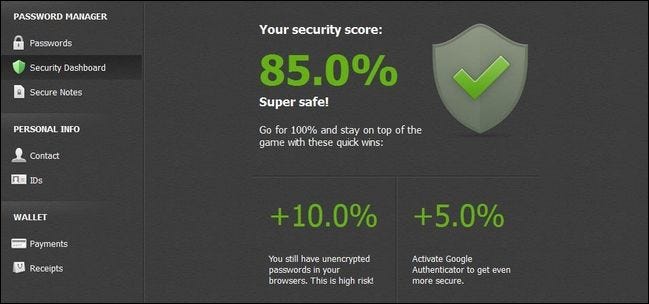
Security Audits. Some password managers have a fantastic feature wherein you can perform an audit on your own password database. It will scan your database and point out when you’re using weak passwords, the same passwords across services, and other password no-nos.
Import/Export. Importing and exporting functions are important password manager components. You want to be able to easily get your existing passwords in (either from another password manager or from the saved passwords in your web browser) and you want a mechanism for easily exporting the password data if need be.
One-Time-Use/Throwaway Passwords. Every password manager has a secure master password that grants you total access to the password management system. Sometimes you may not wish to use that password, however, if you’re not certain of the security of the computer you’re entering it on. Let’s say some pressing emergency compels you to access your password manager on a family member’s computer or a work terminal. A throwaway password system allows you to predesignate one or more passwords to be one-time-use passwords. This way you can log into your password manager once and even if the system on which you do so is compromised that password cannot be used again in the future.
Password Sharing. Some passwords managers include a secure way for you to share passwords with a friend, either inside or outside the framework of that particular password manager.
The Most Popular Password Managers Compared
Now that you have a frame of reference for the important features, let’s take a look at some of the most popular password managers. We’ll discuss them in detail below, but first, here’s a table with an at-a-glance look of each app’s features. In some cases, the answer is more complicated than a simple yes or no and we encourage you to read our more detailed descriptions below where we comment on the nuances of the chart. LastPass, as an example, has a red X for “Offline” because even though it has a backup offline system for access when the Internet is not accessible it is not actually intended to be used that way.
Compare Features
The Best Password Managers
|

LASTPASS |
KEEPASS |

DASHLANE |
1PASSWORD |
ROBOFORM |
| Online |
✓ |
✗ |
✓ |
✗ |
✓ |
| Offline |
✗ |
✓ |
✓ |
✓ |
✓ |
| Two Factor |
✓ |
✓ |
✓ |
✗ |
✓ |
| Browser Integration |
✓ |
✓ |
✓ |
✓ |
✓ |
| Password Capture |
✓ |
✗ |
✓ |
✗ |
✓ |
| Password Changes |
✓ |
✗ |
✓ |
✗ |
✓ |
| Security Alerts |
✓ |
✗ |
✓ |
✓ |
✗ |
| Portable Application |
✗ |
✓ |
✗ |
✗ |
✓ |
| Mobile Application |
✓ |
✗ |
✓ |
✓ |
✓ |
| Security Audits |
✓ |
✗ |
✓ |
✓ |
✗ |
| Import |
✓ |
✓ |
✓ |
✓ |
✓ |
| Export |
✓ |
✓ |
✓ |
✓ |
✓ |
| Throwaway Passwords |
✓ |
✗ |
✓ |
✓ |
✓ |
| Password Sharing |
✓ |
✓ |
✓ |
✓ |
✓ |
Have a few questions about the yes, no, and asterisked entries in the table above? Let’s look at each individual service now.
LastPass
LastPass is one of the most widely known and widely used password managers on the planet. While many of LastPass’ features can be found in other password managers, the service was either at the forefront of pioneering certain features (or significantly improved them). The LastPass security audit, for example, is a top notch experience that really makes it easy to both test the quality of your passwords as well as make changes to improve them.
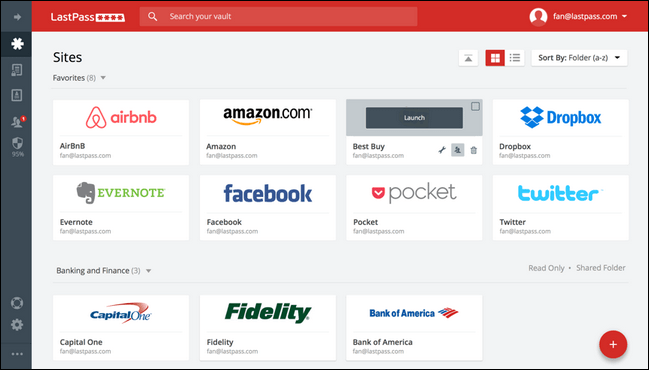
LastPass is primarily a browser extension, though it has standalone apps for Windows and Mac OS X as well. In the above chart LastPass is flagged in the Offline category with an asterisk because while it’s technically an online password management system, it does work offline in certain instances. The actual password database is securely transferred to your device and decrypted there (and not in the cloud) so you can access the database without an active internet connection through your web browser, via the Mac app, or on your mobile device as long as you’ve logged into the cloud once in order to grab the database.
LastPass is free to use on desktop and mobile, though they also have a very reasonable premium model at a mere $12 a year. A buck a month for advanced features is a bargain, even though you can get by without it. You can compare the free and premium features here. (Update: LastPass now costs $36 per year.)
LastPass’ popularity hinges on how easy it is to use, how many features it has for free users, and the fact that it supports iOS, Android, Windows Phones, and even BlackBerry devices. Between the excellent browser integration and the great mobile apps, LastPass really lowers the friction between the end user and good password management.
KeePass
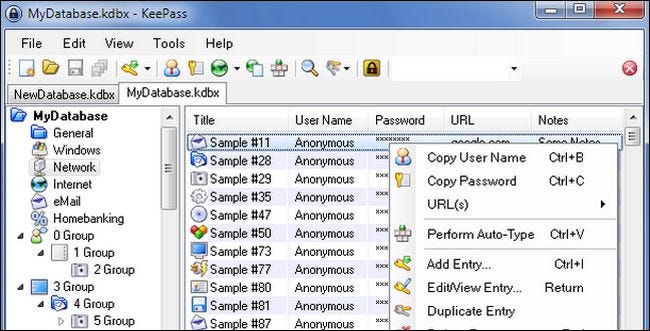
If you bring up popular cloud-based password managers in conversation (especially among tech types) there is bound to be at least one (or several) people who chime in with “There is no way I’d put my passwords in the cloud.” Those people use KeePass.
ADVERTISEMENT
KeePass is, rightfully so, a long-standing favorite among people who want a solid password manager but don’t want to take on the risks (however well-managed and small they might be) of putting their password data in the cloud. Furthermore, KeePass is fully open source, portable, and extensible. (Seriously, the extensions page shows how easy it is for people to make extensions that do everything from improve the KeePass interface to sync the password database to Dropbox.)
Speaking of which, KeePass is technically an offline password manager, but its database can be synced between computers with a service like Dropbox. Of course, at that point, you’re putting your passwords back in the cloud, which invalidates KeePass’ biggest advantage, but it’s there if you want it.
KeePass is the best password manager for the DIYer who is willing to trade the convenience of cloud-based systems like LastPass for total control over (and customization of) their password system. Like an early Linux enthusiast, though, it also means you’re left patching together the system you want on your own terms (there are no official mobile apps, for example, but developers have taken the open source code and adopted it for various platforms). There’s no click, setup, and done with the KeePass system.
Dashlane
Like LastPass, Dashlane has a slick Web 2.0-type interface with a host of similar features–like syncing, password auditing, assisted automatic password changes, and alerts in case of security breaches. Dashlane, however, definitely led the pack in the good interface department–for years, LastPass had a functional but very dated looking interface. Dashlane was the far more polished app, until late 2015 when LastPass finally updated its interface.
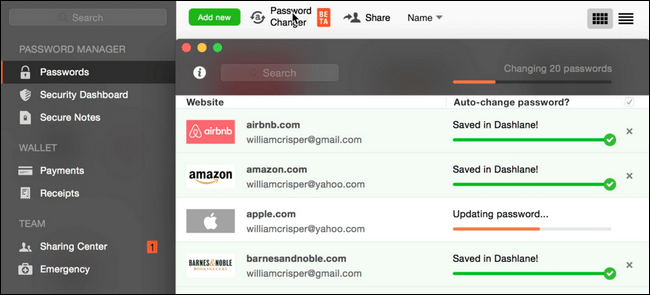
The big difference between the two is the cost of the premium access. Veteran Dashlane users got grandfathered in years ago, but newer users are in for a bit of a sticker shock. To get the same premium upgrades that come with LastPass you’ll have to shell out $50 a year (instead of $36). One of those make-or-break features is online syncing, available only to Dashlane premium members.
ADVERTISEMENT
On the upside Dashlane has something LastPass doesn’t: a hybridization of online/offline functionality. Dashlane is, first and foremost, a local app, and you even get the option when you first set it up to use (or ignore) the online functionality altogether.
If you want the LastPass experience but you like the whole offline aspect of KeePass, Dashlane is a very polished compromise that allows you to start off with local passwords and very easily upgrade to a fully synced and online experience if you desire.
1Password
1Password was originally a premium app for Macs only. However, despite its origins, it now has a Windows app as well as iOS and Android companions. One thing that throws first time shoppers off is the price: Desktop versions of the app are trial only (albeit after the first 30 days the trial is indefinite with limited features) and the mobile versions are free (again with limited functionality). The desktop apps will set you back $49.99 each or you can bundle them for $69.99. The iOS app is $9.99 premium upgrade and the Android app is a $7.99 premium upgrade. (Update: 1Password is now primarily a subscription service, costing $36 per year for one person or $60 per year for a family of up to five people.)
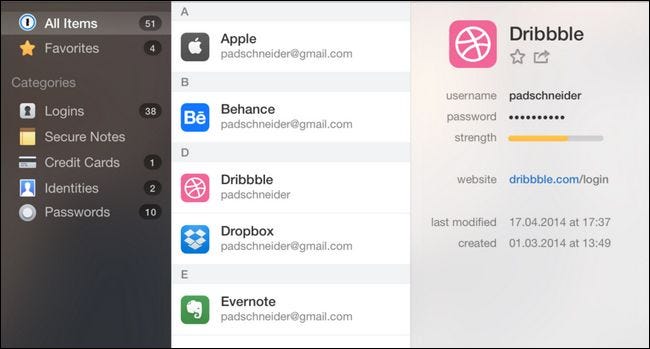
All that said, there is no subscription model for 1Password. So while a desktop and mobile license will set you back around $60 out of the gate, it will be cheaper than a LastPass or Dashlane over time. If you have multiple users in your house, it comes out to be a lot cheaper, since licenses can be shared with up to 6 people living in the same household). The 1Password developers even have a really handy wizard in their store that will guide you through a few simple questions to help you pick out exactly which products you should buy based on your needs.
Like KeePass, 1Password is primarily an offline desktop password manager, but you can manually sync your passwords to your smartphones over USB or Wi-Fi like you would music, or over the internet with a service like Dropbox or iCloud.
In addition to easy syncing and (if you want it) cloud storage via Dropbox or iCloud, 1Password also features very polished browser integration. If you want the offline passwords with a more polished user experience than you’ll get from most other offline managers, 1Password is a solid choice with deceptively competitive pricing.
RoboForm
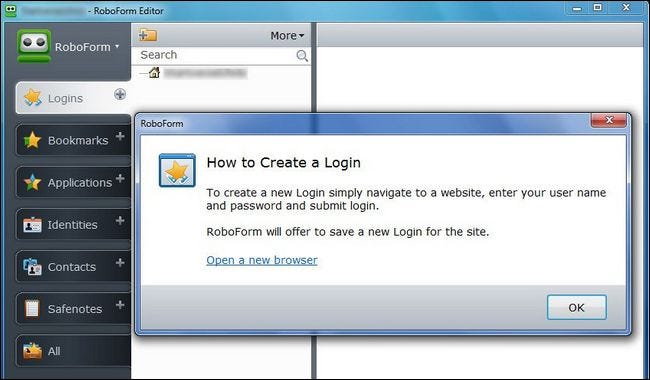
We’ll be the first to admit that RoboForm is a bit of an enigma to us. It isn’t the most feature packed app, and it isn’t the cheapest. But despite more-or-less failing to keep up with the major trends in password management over the last five years, it still has a very large and loyal fan base. Part of this is due to the fact that RoboForm is one of the oldest still-operating password managers out there: it debuted in 1999 and some people have been using it ever since.



 Some powerful photo editors require a monthly subscription fee or a high initial investment. Photopea bucks both of these trends, and instead gives you a free option that doesn’t even require you to download anything.


 Windows 10 won’t hassle you to install an antivirus like Windows 7 did. Since Windows 8, Windows now includes a built-in free antivirus called Windows Defender. But is it really the best for protecting your PC–or even just good enough? Windows Defender was originally known as Microsoft Security Essentials back in the Windows 7 days when it was offered as a separate download, but now it’s built right into Windows and it’s enabled by default. Many people have been trained to believe that you should always install a third-party antivirus, but that isn’t the best solution for today’s security problems, like ransomware. So What’s the Best Antivirus? Please Don’t Make Me Read All This
  What you need is a great team: Malwarebytes + Windows Defender We definitely recommend you read the entire article so you fully understand why we recommend a combination of Windows Defender and
  When you install Windows 10, you’ll have an antivirus program already running.
  Just look at all the extra garbage Avast tries to install alongside its antivirus. Windows Defender does not do any of these things—it does one thing well, for free, and without getting in your way. Plus, Windows 10 already includes the various other protections introduced in Windows 8, like the SmartScreen filter that should prevent you from downloading and running malware, whatever antivirus you use. Chrome and Firefox, similarly, include Google’s Safe Browsing, which blocks many malware downloads. How to Speed Up a Slow PC Volume 0% If you hate Windows Defender for some reason and want to use another antivirus, you can use
  Antivirus is important, but these days, it’s more important that you use a good anti-exploit program to protect your web browser and plug-ins, which are the most targeted by attackers. Malwarebytes is the program we recommend here. Unlike traditional antivirus programs, Malwarebytes is good at finding “potentially unwanted programs” (PUPs) and other junkware. As of version 3.0, it also contains an anti-exploit feature, which aims to block common exploits in programs, even if they are zero-day attacks that have never seen before—like those nasty Flash zero-day attacks. It also contains anti-ransomware, to block extortion attacks like CryptoLocker. The latest version of Malwarebytes combines these three tools into one easy-to-use package for $40 per year. Malwarebytes claims to be able to replace your traditional antivirus entirely, but we disagree with this. It uses completely different strategies for protecting you: antivirus will block or quarantine harmful programs that find their way to your computer, while Malwarebytes attempts to stop harmful software from ever reaching your computer in the first place. Since it doesn’t interfere with traditional antivirus programs, we recommend you run both programs for the best protection. Update: Starting with Malwarebytes 4, the Premium version of Malwarebytes now registers itself as the system’s security program by default. In other words, it will handle all your anti-malware scanning and Windows Defender won’t run in the background. You can still run both at once if you like. Here’s how: In Malwarebytes, open Settings, click the “Security” tab, and disable the “Always register Malwarebytes in the Windows Security Center” option. With this option disabled, Malwarebytes won’t register itself as the system’s security application and both Malwarebytes and Windows Defender will run at the same time. Note that you can get some of Malwarebytes’ features for free, but with caveats. For example, the free version of Malwarebytes program will only scan for malware and PUPs on-demand—it won’t scan in the background like the premium version does. In addition, it doesn’t contain the anti-exploit or anti-ransomware features of the premium version. You can only get all three features in the full $40 version of Malwarebytes, which we recommend. But if you’re willing to forego anti-ransomware and always-on malware scanning, the free versions of Malwarebytes and Anti-Exploit are better than nothing, and you should definitely use them. There you have it: with a combination of a good antivirus program, Malwarebytes, and some common sense, you’ll be pretty well protected. Just remember that antivirus is only one of the standard computer security practices you should be following. Good digital hygiene isn’t a replacement for antivirus, but it is essential to making sure your antivirus can do its job.
 Windows 11 will be free for upgrades from window 10 but there are system requirements. The one that will eliminate a lot of older PS’s and Laptops is the requirement for a TPM Chip (Trusted Platform Module. You can check your PC with the PC Health check app
